هدوء (Hudou): AI Mental Health Intake
TCS Sustainathon Saudi Arabia 2026 · AI for Community Health & Well-being · Team Mentalicious
Hudou (هدوء, “calm”) is named after the feeling people are looking for, not the label they are avoiding. It meets people at a physical complaint they are willing to name, checks for a medical cause first, and hands the clinician a ready summary. Built by Elyas AlTurkistani, Omar Bin Talib and Sulaiman AlAngari, it placed in the top 5 of ~500 registrations at the grand finale in Riyadh.
Two problems, not one
- Too few clinicians: about 1.3 psychiatrists per 100,000 people, against roughly 49 mental health workers per 100,000 needed; a shortfall of about 10,400 people, mostly nurses and counsellors.
- Nobody comes forward: in a survey of 480 Saudi medical students, about 1 in 3 showed signs of depression and few used any service; shame ranked above cost and distance, and a study of 1,077 students found the same.
Existing services (anonymous therapist booking, public telehealth, general chatbots) work on the first problem. You still have to decide you need therapy before you open them.
The intake
- Symptom first: the user starts with a headache, chest tightness or broken sleep.
- Rule out the body: fever, weight loss, sudden pain or numbness route to a regular doctor. Headaches can also be thyroid disease or sleep apnoea, so the system assumes physical until physical is excluded.
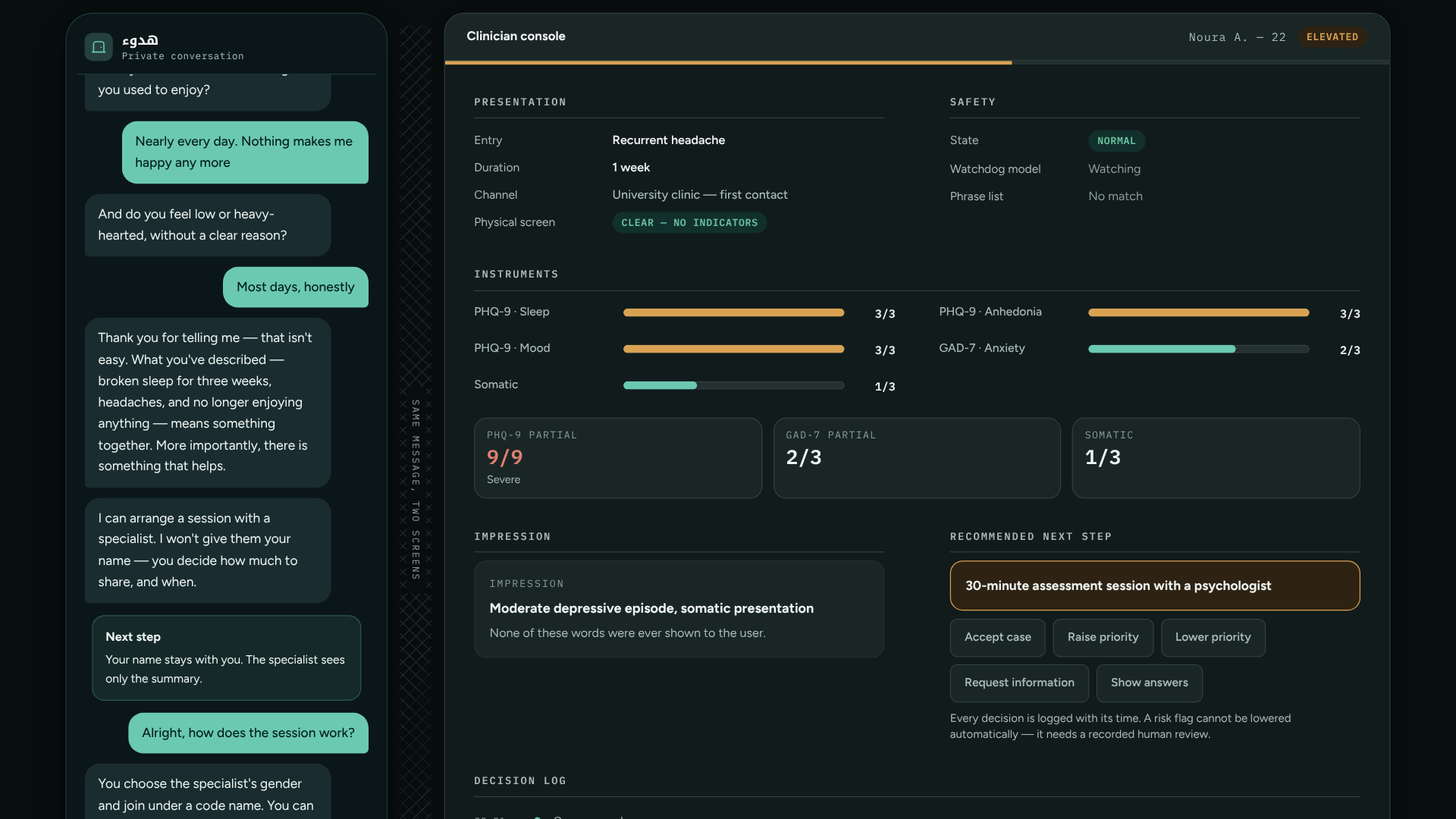
- Talk how they talk: PHQ-9 and GAD-7 asked as conversation in Jeddah and Riyadh dialect.
- One page, not a chat log: symptoms, duration, scores and warnings with an urgency grade, in a queue sorted by risk instead of arrival time.
- Privacy step by step: the diagnosis appears on the clinician's screen, never on the user's.
Safety
Warning states run Normal → Concern → Risk flag → Human contact. A separate model watches every message in parallel, so the conversational model never judges itself, and a fixed list of risk phrases sits underneath as a backstop. A risk signal stops the conversation, shows the national helpline and brings in a person, with human contact targeted in under five minutes. The AI never handles an emergency alone, false alarms are accepted and reviewed, and the clinician can overrule any automated judgement, with every decision logged.
Privacy in four steps
| Step | What the user gives up | What the clinician sees |
|---|---|---|
| 1. Just talking | Nothing; no account, nothing saved | Nothing |
| 2. Share the summary | The summary goes over, the name does not | Symptoms, scores, warnings |
| 3. Session under a code | A live session; the user picks the clinician's gender | A person, not a name |
| 4. Full record | Identity, only when a psychiatrist assesses medication | The whole history |
Data is hosted in the Kingdom under the national data protection law, with code names instead of real names, and the conversation itself is never stored. Because it sorts people by urgency, the team's reading of SFDA guidance MDS-G27 is that Hudou counts as medical software rather than a wellbeing app.
How it would be tested
The core claim is that wording changes behaviour. Version A says “this looks like depression”; version B says “your sleep has been broken for three weeks and it is making everything harder”. 15 to 20 students are split at random and the measure is how many agree to speak to a person. The bar was fixed in advance: B must win by at least 10 in every 100, or the claim is dropped.
Impact (a model, not a measurement)
A first appointment takes about 50 minutes, mostly history-taking. If the history arrives written, review and confirmation take about 15, so a clinician seeing 6 new patients a week would gain about 3.5 hours, roughly 180 extra sessions a year. These inputs are assumptions from typical practice and the first thing to check with clinicians.
The prototype
A bilingual (Arabic and English) interactive prototype shows the patient's phone beside the clinician's console across three scenarios: the usual path, a physical cause that leaves the flow, and a risk signal that escalates immediately. It uses representative data and is not a medical device. Still unproven: the wording hypothesis, dialect handling beyond prompt engineering, and the impact assumptions, which need clinician interviews.
Recognition
Top Finalist certificate from Tata Consultancy Services, signed by Sudhir Sreedharan, Regional Director for Saudi Arabia, Bahrain and Kuwait.