Studying Numerical Literacy Across Generations in U.S. Households
Longitudinal Econometric and Machine Learning Analysis (1970 – 2025)
Does being good with numbers as a child follow you into adulthood, pass to your own children, and show up in your wealth? Omar Bin Talib and Aws Alsaedi studied this with nationally representative, multigenerational U.S. data, mentored by Professor Michael Boutros, during a 440-hour placement at the Data Sciences Institute through the KAUST Academy.
Questions
- Does numerical literacy persist within a person over time?
- Is it transmitted from parents to children?
- Is childhood numeracy linked to adult wealth?
- Which family factors predict it?
Data
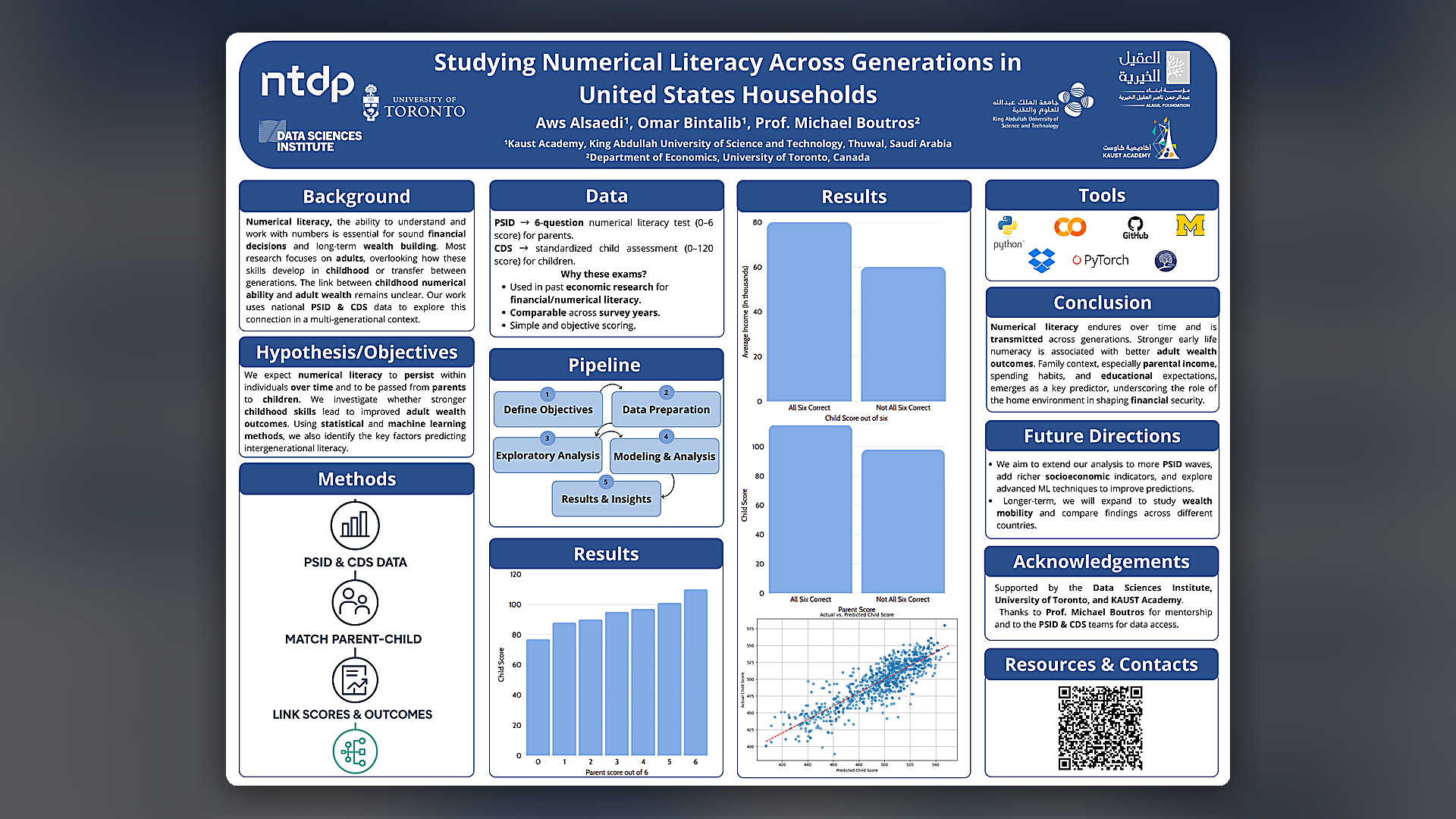
The Panel Study of Income Dynamics (PSID) gives parents a six-question numeracy test (scored 0 to 6); its Child Development Supplement (CDS) gives children a standardized assessment (scored 0 to 120). Linking each child's scores to their parents' scores and to their own later outcomes produced matched parent–child pairs and longitudinal follow-ups.
My part
- Led the end-to-end data engineering that merged PSID and CDS across survey waves, with a memory-aware chunking pipeline for the large joins.
- Handled preprocessing, missing data and exploratory analysis, and harmonized test-score scales across years.
- Built the socioeconomic features, then implemented and compared regularized regressions, Gradient Boosting, Random Forest and XGBoost, with feature-importance analysis of what drives child scores.
Findings
- Transmission is continuous, not binary: child scores rise steadily with each extra question the parent answers correctly, and children of parents with a perfect 6 of 6 score higher on average.
- Children who answered all six questions correctly have higher average adult income.
- The strongest predictors of a child's long-term numeracy were parental income, household spending patterns and parents' educational expectations.
- The models' predictions track actual child scores closely (R² around 0.80), so the same family factors that explain the outcome also predict it.
The findings were presented at the SUDS 2025 Research Showcase to 30+ faculty and researchers. Hard parts included codebook ambiguities, standardizing scores across survey years, and balancing interpretable statistics against predictive ML.